



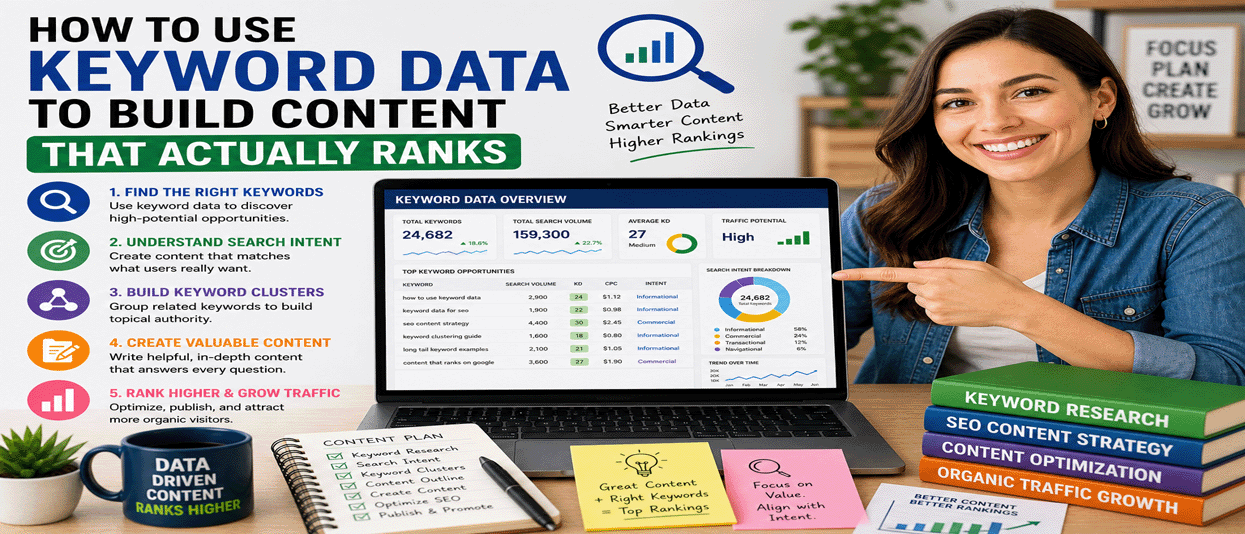
Keyword data is one of the most valuable tools in SEO because it shows you what people are searching for, how they phrase their questions, and what kind of content they expect to find. When used correctly, keyword data can help you build content that actually ranks instead of content that gets ignored.
The key is not just collecting keywords. The real power comes from turning keyword data into a focused content strategy that matches search intent, answers real questions, and gives Google a clear reason to rank your page.
What Is Keyword Data?
Keyword data includes information about search terms people use online. This may include search volume, keyword difficulty, cost-per-click, competition level, related keywords, questions, and trends.
When you understand this data, you can make better decisions about what content to create and which keywords are worth targeting.
Why Keyword Data Matters for SEO Content
Many website owners create content based on guesses. Keyword data removes much of that guesswork by showing you what your audience already wants.
- It helps you discover topics people are searching for
- It reveals long-tail keyword opportunities
- It helps you understand search intent
- It shows which topics may be too competitive
- It gives structure to your SEO content strategy
Step 1: Start With the Main Keyword
Every strong SEO page should begin with one main keyword. This keyword represents the primary topic of the page. For example, the main keyword for this article is keyword data.
Your main keyword should be specific enough to guide the article but broad enough to support related subtopics.
Step 2: Study Search Intent
Search intent is the reason behind the search. Before writing content, ask what the searcher wants. Are they trying to learn, compare, buy, or solve a problem?
- Informational: “how to use keyword data”
- Commercial: “best keyword research tool”
- Transactional: “buy SEO software”
- Problem-solving: “why is my content not ranking”
Content that matches search intent is more useful to readers and more likely to perform well in search results.
Step 3: Find Supporting Keywords
Supporting keywords help search engines understand the depth of your topic. These include related phrases, long-tail keywords, questions, and keyword variations.
For an article about keyword data, supporting keywords might include:
- SEO content strategy
- keyword research
- search intent
- long tail keywords
- keyword clusters
- organic traffic
Step 4: Build a Keyword Cluster
A keyword cluster is a group of related keywords that support the same topic. Instead of writing separate thin articles for every keyword, you can build one stronger page that covers the topic completely.
Keyword clusters help your content become more useful, more organized, and easier for search engines to understand.
Step 5: Create an SEO Content Outline
Before writing, turn your keyword data into a clear outline. Each major keyword or question can become a section of your article.
A simple SEO content outline may include:
- Introduction with the main keyword
- Definition of the topic
- Why the topic matters
- Step-by-step instructions
- Examples
- Common mistakes
- Checklist or summary
- Conclusion with a call to action
Step 6: Write for People First
Keyword data helps guide your content, but your article should still sound natural. Avoid stuffing keywords into every sentence. Instead, use keywords where they make sense and focus on helping the reader.
Strong SEO content is clear, useful, organized, and easy to read.
Step 7: Optimize Important SEO Areas
Once your article is written, place your keywords in the most important SEO areas.
- Page title
- Meta description
- H1 heading
- H2 headings
- First paragraph
- Image alt text
- URL slug
- Internal links
Step 8: Use KeywordRetriever.com for Smarter Planning
KeywordRetriever.com can help users collect keyword ideas, organize keyword data, and build better SEO content plans. By using keyword insights before writing, you can create content around real search demand instead of guessing.
This makes your content strategy more focused and gives each page a stronger chance to rank.
Suggested SEO Plan for This Article
- Main Keyword: keyword data
- Secondary Keyword: SEO content
- Supporting Keywords: content that ranks, keyword research, search intent, long tail keywords, keyword clusters, SEO content strategy
- Suggested URL: /use-keyword-data-build-content-that-ranks
- Suggested Image Alt Text: keyword data dashboard used to build SEO content that ranks
Final Thoughts
Keyword data turns SEO content creation from guesswork into strategy. It helps you understand what people search for, what they expect, and how to structure content that can perform better in Google.
Use keyword data to choose better topics, match search intent, build keyword clusters, and create helpful content. With a smart process and a tool like KeywordRetriever.com, you can build SEO content that has a much better chance of ranking and bringing in organic traffic.
Keyword Related Articles